There's a particular kind of drive home after a bad round. As you reflect on the three-putt on seven, the snap hook out of bounds on twelve, the chip you bladed through the green when the match was on the line. By the time you get home, you've either made a decision to change everything about your game, or you've decided to block the whole thing out and never think about it again.
Both are wrong. And both are why most golfers don't improve.
The rounds that feel worst are, counterintuitively, the most instructive. They contain information that good rounds can't give you: where your game breaks under pressure, which parts of your swing revert when you're fatigued, what your real weaknesses are rather than the ones you've been comfortable blaming. But only if you actually process them rather than forget them.
That's what a golf journal is for. Not as a record of scores, but as the tool that turns experience into information. Here's exactly what to write after a round that went badly.
First: wait until the emotion has settled
This matters more than the format. Writing in the car park while you're still furious is not particularly useful. The frustration will dominate the analysis, and you'll end up with a journal entry that reads like a list of grievances rather than a coaching document.
Give it an hour. Let the heat come out of it. Then sit down and write with a specific goal: not to relive the round, but to understand it.
Creating this habit trains your brain to be mindfully present in the moment, a skill that can be trained and will undoubtedly improve performance. The act of reflection changes how you process and retain the experience.
What to write: the five sections
1. The score in context
Start with the basic facts: score, course, conditions. But go one layer deeper than just the number. Was it a windy day? Were the greens unusually fast? Were you tired coming in after a long week of work? Were you in a match situation that created extra pressure?
Context can explain a bad score. And understanding why a score happened is the first step to knowing whether it reveals a pattern or was simply a difficult day.
Write two or three sentences. You're not looking for excuses, but you're establishing the conditions under which the score was played.
2. Where the strokes actually went
This is the analytical core of the entry, and it requires you to be specific rather.
Most golfers, reflecting on a bad round, default to general assessments: "my driving was all over the place," "couldn't hole anything." These feel accurate but are limited to improve upon, because they don't tell you which situations went wrong or how often.
Instead, work through the round shot by shot, or, if you use tools like Garmin, let the numbers guide you. Identify the three situations that cost you the most strokes. Not necessarily the worst shots, but the patterns. The sixth hole might have been memorable for a terrible bunker shot, but if you only hit one bunker all day, that's a single incident, not a pattern. The fact that you missed four of your five approach shots from 150 metres is a pattern.
Ask yourself:
- Which club or shot type let me down more than once?
- Was there a specific distance or situation where I repeatedly underperformed?
- Were the big numbers the result of one bad shot or a chain of mediocre ones?
Try to find objectively which parts of your game leaked, rather than which ones felt like they leaked. The two are often different.
3. The mental and emotional notes
Golf is unusual among sports in that the mental dimension is often more influential than the technical one in a given round. A bad round frequently has a psychological cause that a purely statistical review will miss.
Write honestly about this section. Some questions to work through:
- Was there a moment when you mentally checked out?
- Did a bad shot on an early hole affect your focus for the rest of the round?
- Were you anxious coming down the back nine, and if so, when did that start?
- Was there a situation that triggered something you didn't handle well?
By noting down your thoughts, feelings, and reactions to different situations on the course, you can gain a better understanding of how your mindset affects your performance. Over multiple entries, these notes reveal patterns beyond the scorecard. Certain types of pressure that consistently derail you, specific holes or situations that trigger anxiety, or the point in a round where your focus tends to fade.
This isn't about being hard on yourself. It's about treating the mental game with the same analytical seriousness you bring to your swing.
4. The one thing that actually went well
This section exists for two reasons. First, because even bad rounds contain useful data about what's working, and knowing your strengths is as important as knowing your weaknesses. Second, because a journal that only records failure is demoralising to return to, and you need to actually return to it for it to be useful.
Find one thing, maybe that one specific shot, one club, one decision on course, that was genuinely good. Write it down. For example, "My driving distance and accuracy held up even when everything else fell apart" is useful information. It tells you that under pressure, your tee game is reliable. That's worth knowing.
5. The one thing to take to the range
The final section is the most important for actually improving, and it's the one most golfers skip.
After a poor round, the temptation is to arrive at the range and hit everything. Find ways to rebuild your game from scratch, to fix the drive and the irons, and the chipping and the putting, all in a single session. This is how you spend two hours at the range and make no progress at all.
Instead, close your journal entry with a single, specific sentence that describes exactly what you're going to practise next. Not "I need to work on my irons" but "I'm going to spend thirty minutes hitting approach shots from 140 metres, focusing on keeping the ball out of the right bunker." The specificity is what makes it actionable.
This sentence, written while the round is still fresh, is what connects experience to practice. Without it, the journal is just a diary, which is still beneficial, as this data can be used with a coach (or AI-Coach).
What not to write
A few things to avoid:
- Don't write swing mechanics during the entry. Your round notes are for performance analysis, not technical reconstruction. "I was coming over the top" might be accurate, but technical fixes belong in a separate section and should come from a coach or a swing analysis, not from your memory of how a shot felt under pressure.
- Don't be so negative that it's demotivating. Honesty is essential, but a journal that reads as pure self-criticism becomes something you avoid returning to. Documenting successes along the way and using positive reinforcement provides valuable data and motivation.
- Don't skip it because the round was too bad. The rounds you most want to forget are the ones where the journal does the most work. If the round was bad enough that you're considering skipping the reflection, that's a sign you should write more, not less.
The pattern you're looking for
A single journal entry is a snapshot. Its real value compounds across entries, when patterns start to emerge that aren't visible from inside any individual round.
After ten to fifteen rounds of honest journaling, you'll typically start to see the same themes reappear: a specific club that lets you down under pressure, a mental pattern (checking out after a bad start, tensing up on back nines), a distance range where your approach play consistently leaks shots.
These patterns are the real product of the journal. They tell you what to practise with far more precision than any general coaching advice, because they're drawn from your own game, your own patterns, your own tendencies under real conditions.
The bad round is where they become visible. Writing it down is how you catch them before they cost you more shots.
--------
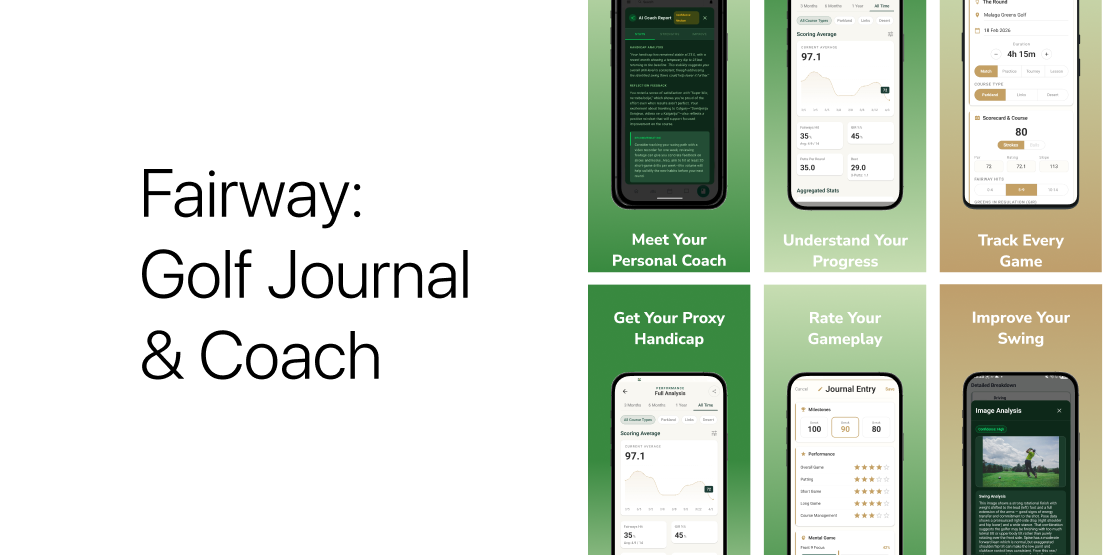
Fairway makes this process automatic. Logging your round data, identifying patterns across sessions, and turning them into focused coaching guidance. Download free on iOS and Android and start your first coaching report today.
---------
Frequently asked questions
What should I write in a golf journal? A golf journal should include the round's basic context (score, course, conditions), a specific analysis of where strokes were lost rather than vague impressions, notes on your mental and emotional state during the round, at least one thing that went well, and a single specific focus to take to your next practice session.
How do I process a bad round in golf? Give yourself an hour for the immediate frustration to settle, then sit down and analyse the round with a specific goal: understanding it rather than reliving it. Work through the situations that cost you the most strokes, note any mental patterns (checking out, anxiety, loss of focus), and write down one specific thing to work on at the range. The rounds that feel worst are often the most instructive if you process them systematically.
Should I write a golf journal after every round? Yes, ideally after every round, but the entry doesn't need to be long. Even five minutes of structured reflection (where did strokes go, what was the mental story, what's the one practice focus) is far more valuable than a detailed entry written only after exceptional rounds. Consistency matters more than depth. The patterns you're looking for only emerge across multiple entries.
How does golf journaling help you improve? Golf journaling creates a feedback loop between rounds that most golfers don't have. Instead of relying on impressions and feelings about how your game is performing, a journal identifies real patterns. Over time, it shows you which parts of your game consistently underperform, which mental situations you handle poorly, and where practice time is most needed, based on your own game rather than generic advice.
What's the difference between a golf journal and just tracking stats? Stats tracking gives you numerical data (strokes gained, greens hit, putts per round). A journal adds the layer of context and interpretation that makes data useful: why those numbers came out the way they did, what the mental story was, and what specifically needs to change. The most effective approach combines both: use data to identify what happened, use the journal to understand why. Together they produce the kind of personalised coaching feedback that generic stat tracking can't provide on its own.