Golf is one of those games where the result is easy to measure, but hard to understand.
You know your score. You know if you played better or worse than last time. You probably remember the terrible drive into the trees, the missed short putt, or the bunker shot that ruined the hole. But that does not always mean you know what actually affected your round the most.
That is why I started thinking about the idea of a golf journal.
The inspiration came partly from Ben Hogan’s Five Lessons, and from the idea that improvement in golf is a process. You learn from experience, but only if you actually capture that experience. Golf is never static. Your body changes. Your swing changes. Courses change. Weather changes. Equipment changes. Your confidence changes. Even the same course can feel completely different from one day to another.
So the point of a golf journal is not to write a diary for the sake of writing.
The point is to build memory for your game.
Your handicap tells part of the story, but not the whole story
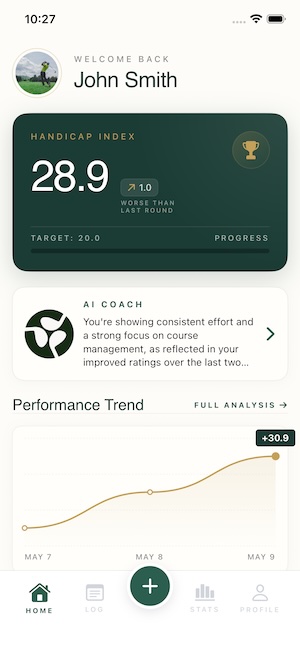
Most golfers know their handicap or at least have a feeling for the level they usually play at. But a general average does not always tell you enough.
Playing like a 24 handicap on an easier course is not the same as playing like a 24 handicap on a difficult course. Playing well in perfect weather is not the same as keeping your score together in wind, rain, pressure, or after a bad start.
That is why the app focuses not only on your general handicap trend, but also on how you played in context.
At a very high level, a handicap-like performance estimate looks at your score in relation to the course. It is not just “how many shots above par did I play?” It also considers things like course rating and slope, because different courses have different difficulty levels. This gives you a better idea of how strong your round actually was.
But even that is still only the beginning.
Because knowing what you played is useful. Understanding why you played that way is where improvement starts.
Capturing the signals behind the score
After a round, most of us remember a few emotional moments. The great shot. The terrible shot. The unlucky bounce. The three-putt. The hole where everything collapsed.
But those memories are biased. They are loud, but not always statistically important.
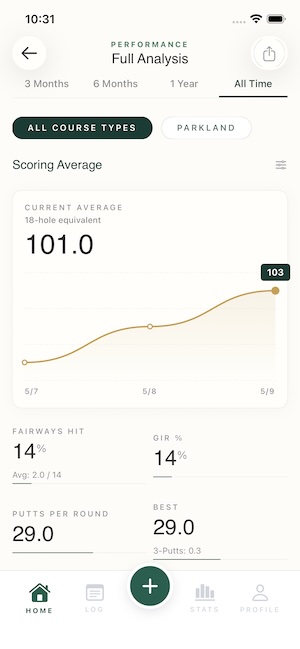
That is why the journal asks for simple signals around your round.
How did you feel mentally on the front nine and back nine?
How did your putting feel overall?
Were your putts mostly short, medium, or long?
What felt like the main reason your score suffered — swing, putting, short game, tactics, mental game, or a mix of several things?
What do you want to write down while the round is still fresh?
The idea is not to force you into complicated tracking. You should not need to count every tiny detail manually after every hole just to learn something useful.
Instead, the goal is to capture enough context to understand the round later.
Maybe your score was not bad because your swing collapsed. Maybe you were fine tee to green, but lost shots around the green. Maybe your putting was not as terrible as it felt, but your tactics put you in bad positions all day. Maybe your front nine was solid, but after one bad hole your mental game broke and the back nine became damage control.
These are the kinds of patterns that are very hard to see from memory alone.
Why AI coaching belongs on top of the journal
Nothing replaces a good golf coach.
A real coach can see your swing, your movement, your habits, your setup, your tempo, your confidence, and the small details that software will never fully replace. If you have regular access to a good coach, that is still one of the best ways to improve.
But most amateur golfers do not have a coach on quick dial.
Most of the time, we are alone. We play alone, practice alone, think alone, and often guess alone. And because we are human, we are biased.
We practice what annoys us the most.
We remember the most painful mistakes.
We assume the loudest problem is the biggest problem.
We go to the range and hit the same club again and again because it feels like the obvious thing to fix.
But what feels obvious is not always what matters most for the score.
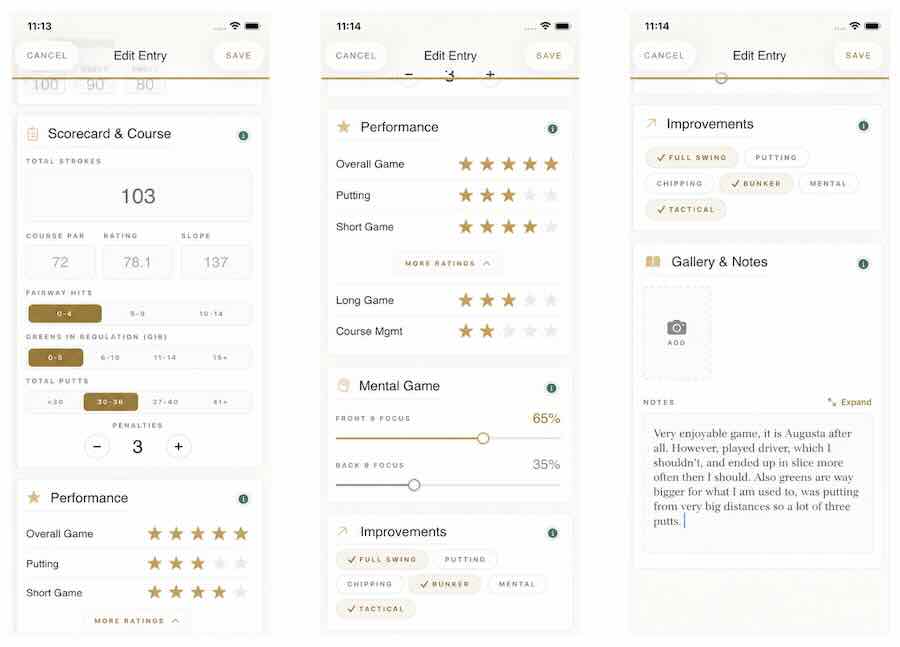
This is where AI coaching can help.
Not as a replacement for a coach, but as a non-biased second brain that looks at your rounds, practice sessions, notes, stats, and trends together. It can help you understand what your data is actually saying, instead of only reacting to the last emotional memory from the course.
Maybe it cannot always point you in the perfect direction. But it can often point you in a better direction than pure guesswork.
Practice matters more when it connects back to your game
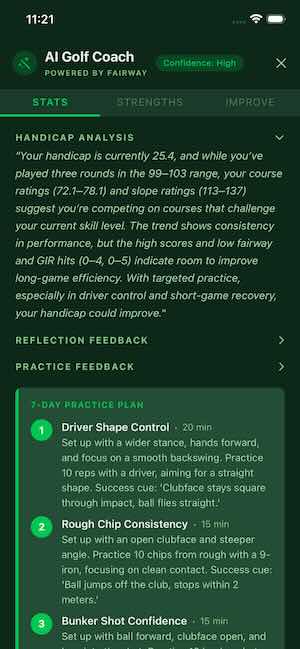
Journaling is not only for rounds. Practice matters too, but only if it helps you understand how your practice connects to your actual performance.
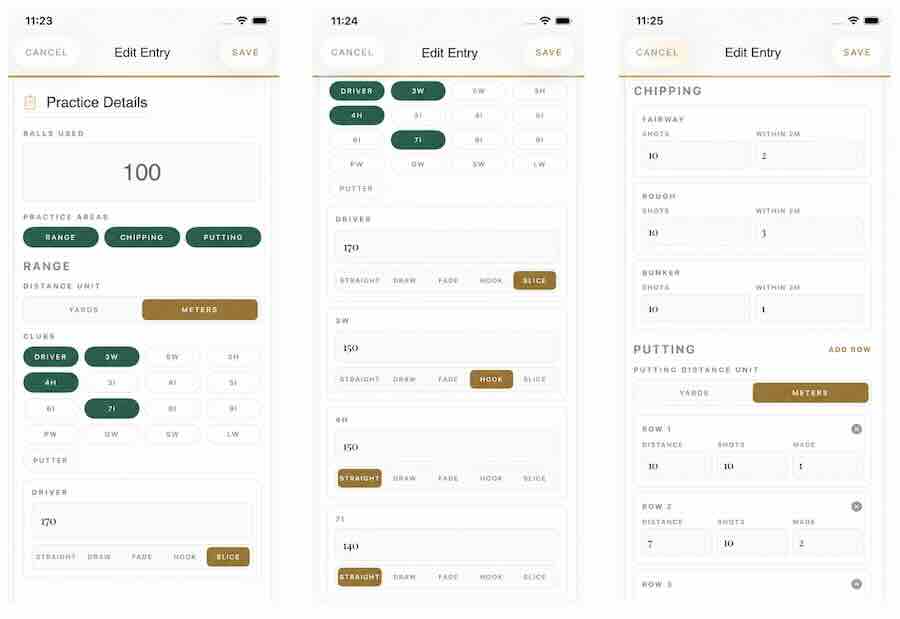
A range session can help you understand your average distances per club and the ball shapes you usually produce — straight, slice, hook, pull, push, or something else. This is especially useful because many golfers have a very optimistic idea of their distances. They remember the best strike, not the average one.
Short game practice can tell a different story. Chipping from the fairway is not the same as chipping from rough or from a bunker. The useful question is not only “did I practice chipping?” but “how often did I leave the ball close enough to realistically save the hole?”
Putting practice has another layer. From what distances are you putting? How often do you hole it? How often do you leave yourself a safe second putt? How often does a short putt become a mental problem?
On their own, these practice numbers are useful.
But they become much more useful when they are connected to your rounds.
If your practice data says you are weak from 1.5 to 2 meters, and your rounds show that missed short putts are costing you confidence, that is useful. If your range data says your driver slices most of the time, and your rounds show repeated penalty shots from the tee, that is useful. If your short game practice is improving, but your score is not, maybe the issue is somewhere else.
The more connected the data is, the better the coaching context becomes.
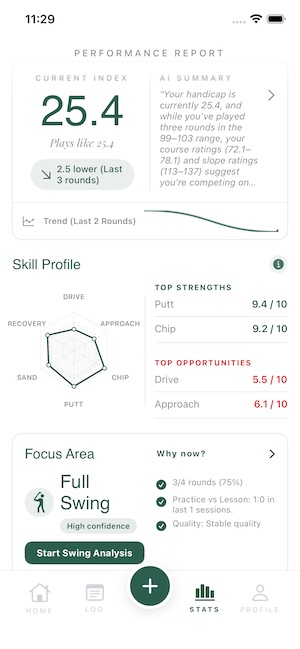
Performance reporting: golf is simple, but the numbers are not
Golf looks simple from the outside.
Hit the ball. Find it. Hit it again. Get it into the hole in as few shots as possible.
But understanding performance is much harder.
Especially today, with all the technology around golf, it is easy to drown in numbers without knowing what they mean. Carry distance, total distance, club speed, ball speed, launch angle, dispersion, putting averages, handicap trends, strokes gained, fairways hit, greens in regulation — all of it can be useful, but only if it helps you make better decisions.
For many higher-handicap golfers, the biggest challenge is not the lack of data. It is understanding what actually affects the score.
One less putt per hole can change your score dramatically. Playing a safer 150-meter iron from the tee can sometimes be much smarter than hitting a 180-meter driver that slices into trouble most of the time. Avoiding one mental breakdown after a bad hole can save more shots than finding five extra meters of distance.
This is where performance reporting and AI coaching become powerful together.
The app can help you see not only what happened, but what may be worth your attention next. It can connect your feelings, your round results, your practice patterns, your putting, your swing tendencies, and your tactical choices.
And that matters because golf becomes more enjoyable when you understand what is happening.
Not because every round becomes perfect. It will not.
But because a bad hole does not have to become a mystery. A bad score does not have to become “I am terrible at golf.” A frustrating round can become information.
Where swing analysis fits in
At some point, every golfer zooms in on the swing.
That makes sense. The swing is important. If your setup, posture, stance, hip movement, hand position, or head stability are causing problems, you want to know.
Swing analysis is useful because it can give you immediate feedback. Based on the video quality, camera angle, and visibility of the body, it can analyze important parts of your movement and explain them in normal language.
For example:
“Your hips are swaying during the backswing.”
“Your stance looks too narrow.”
“Your head is moving too much through the swing.”
“Your hand position at setup may be affecting your consistency.”
Even more importantly, it can show the difference between what you are doing and what a better position may look like. That gives you something actionable to try immediately on the range.
[Screenshot idea: Swing analysis with body angles / posture comparison]
But swing analysis also has limits.
It can help you understand a movement problem. It can help you test a correction. It can help you prepare better questions for a real coach.
But it does not replace the bigger picture.
If you slice your driver 80% of the time and still keep using it on a hole with water on the right, that is not only a swing problem. That is also a tactical problem.
If you spend every practice session trying to hit the ball farther, but your score is mostly suffering from putting, short game, or mental breakdowns, then distance may not be the priority.
Swing analysis is powerful when you know why you are using it.
It is not the whole game. It is one tool inside the bigger process.
The goal: understand your own game better
The goal of journaling, statistics, AI coaching, and swing analysis is not to make golf mechanical.
The goal is the opposite.
It is to help you understand your own game well enough that you can enjoy it more.
You start seeing patterns. You understand which problems repeat. You know what to practice. You know when something is a swing issue, when it is a tactical issue, and when it is mental. You can go to a coach with better questions. You can stop defaulting to “I need more distance” every time something goes wrong.
Golf improvement is long term. One round does not define you. One swing video does not explain everything. One practice session does not change your game.
But over time, the data becomes useful.
Your journal becomes your memory.
Your stats become your map.
Your AI coach helps connect the dots.
Your swing analysis helps you zoom in when the swing really needs attention.
And together, they help you answer the most important question after every round:
What should I work on next?