The honest answer of what AI does well, what it doesn't, and why the question itself might be the wrong one.
The moment you search "AI golf coach," you're hit with two very different kinds of content. On one side: a promise that an app can replace your existing coach, and on the other, a sceptical golf writer insisting that nothing beats a qualified coach. Both are right from their perspectives, but miss the other perspective.
The actual research from biomechanics labs, sports science journals, and coaching psychology tells a more interesting and more useful story. AI can already do some things better than a human coach working alone, does other things worse, and is closing the gap quickly. For golfers trying to improve without daily access to a coach, understanding which is which is genuinely useful.
What does AI Coaching mean?
Most of the confusion in this debate comes from treating AI coaching as a single capability. It isn't. It covers at least three fundamentally different things, and the research verdict on each is different.
The first is swing analysis: using computer vision to detect body positions, joint angles, swing path, and club face at impact from a video. The second is performance analytics: processing round data, stats, and logged sessions to identify patterns, weaknesses, and trends over time. The third is coaching dialogue: a conversational AI that responds to your questions, sets goals, and gives guidance the way a human coach would.
Ask whether AI can analyse your swing mechanics: the evidence is strong. Ask whether AI can replace the intuition of a coach who has spent twenty years watching golfers under pressure: it can't. Treating these as the same question is why the debate generates more heat than clarity.
Swing Analysis: What the research actually shows
The research here is the most mature, and it's genuinely compelling.
Computer vision systems trained on large datasets of golf swings can now reliably segment all eight phases, from address through impact to finish, and measure joint angles, rotation, and sequencing against reference models. A recent study from the Auckland University of Technology introduced a deep learning model that achieved a classification accuracy of 96.88% for detecting swing defects, substantially higher than earlier baseline models.
What makes this significant for club golfers is the access to these insights. For decades, this kind of biomechanical measurement required laboratory conditions, motion capture suits, and equipment costing tens of thousands. Research from New Zealand's Sports Performance Research Institute found that modern inertial measurement units now produce biomechanical feedback with strong correlation to lab-grade systems, accurate to within two degrees on key metrics. The same quality of data that elite players obtain through coaches and specialist hardware can now come from an iPhone video.
Bryson DeChambeau's collaboration with Google illustrates where Swing Analysis capability is heading. The system tracks more than 30 key points on the body, club, and ball, detecting subtle variations in pelvis lift, chest rotation, and body positioning that would be difficult to catch through traditional video review. He uses it minutes before competitive rounds. The underlying technology is now available to any golfer with a smartphone.
One honest limitation: AI systems analyse based on predefined models that are still improving. They may not account for individual anatomical differences without being explicitly prompted in AI Coach. A golfer with an unusual build can get flagged for positions that are actually optimal for them. This is where a human coach's interpretation still adds real value. The data tells you what happened, but a coach can tell you whether it matters for your specific body.
Performance Analytics: Clear advantage to understand data
Performance analytics is arguably where AI outpaces a human coach working alone, and it's the capability that most golfers underestimate.
A coach watching you hit balls for an hour works from what they observe in that session. They're skilled at reading your swing in real time. What they can't see is that you lose 1.4 shots per round from the 100–150 metre range, specifically, that your putting from inside two meters has deteriorated across your last eight rounds, or that your iron contact is measurably worse on back nines in a way that points to fatigue rather than technique.
That kind of longitudinal pattern analysis is exactly what AI does well. A single lesson tells a coach relatively little about your actual game. Dozens of logged rounds reveal something a lesson never can: how your game performs under real conditions, over time, across weather, courses, and pressure.
Research published in Entropy demonstrated that AI-based game planning and analytics systems move away from one-off calculations toward running insights that genuinely improve as more data is gathered. The more you log, the more specific and accurate the insights become.
This is what "your coach needs to know your whole game" actually means in practice. Most golfers get occasional lessons and feedback. AI coaching, done well, builds a continuous record.
Coaching Dialogue: Where human coaching still wins
Coaching dialogue with AI Coach is where the evidence is more mixed, and where honesty matters.
A 2024 study in Frontiers in Psychology compared participants working with an AI coach versus a human coach. The results were surprising. Participants built similarly high levels of working alliance with both, but the same research identified a structural limitation: AI coaches perform better when designed with a specific, narrow focus. Current AI capabilities struggle to match the breadth and adaptability of an experienced human coach across the full range of a coaching relationship.
A skilled human coach isn't just delivering technical information. They're reading your mood, noticing when you're tense, adjusting their language to what works for you, and drawing on years of watching different golfers struggle with similar problems. Golf isn't only a physical game; the mental and emotional dimensions are important, and a good coach is attuned to them in ways an algorithm isn't.
There's also a more specific problem worth naming. Large language models have a documented tendency toward sycophancy. They agree, validate, and go along with what the user says rather than pushing back. A skilled coach surfaces what you're avoiding, like challenging the story you've told yourself about your game, and naming the real problem even when it's uncomfortable.
None of this means conversational AI coaching has no value. For answering questions between lessons, creating structured practice plans, and reviewing your logged data in plain language, it's genuinely useful. It's just not a full substitute for a coach who knows you as a person.
The framing that gets it right
Bryson DeChambeau put it better than most when describing his own use of AI analysis tools: "I don't think AI is going to take over the role of coaching, but I can see it being a supplement to coaches from here on out. It's a great tool in the toolbox."
Supplement, not replacement. That framing is supported by the research. The most effective approach combines AI's data capabilities with human coaching expertise rather than forcing a choice between them. A coach reviewing an AI analysis of your last twenty swings before your lesson is better equipped to help you. And a golfer who arrives with logged rounds, trend data, and specific questions has a more productive lesson than one relying on memory and feel.
What this means practically
For a golfer without a coach in their pocket every week, the practical implications are significant.
AI swing analysis means objective, repeatable feedback on your mechanics without booking a lesson every time you want to check something. You can track whether a swing change is actually taking hold or quietly reverting. You can catch the fault before it does damage.
Performance analytics means replacing the vague sense that "my short game is letting me down" with the specific knowledge that your pitch shots from 30–50 metres are costing you more shots than any other part of your game. That precision changes what you practise and how.
A coach who knows your full history, your previous attempts at fixes, and how your game has trended over time means the guidance you receive is genuinely personalised, not generic advice.
Together, these capabilities close a gap that most improving golfers know well: the feedback loop between rounds is too long, too vague, and too dependent on memory rather than data. The question isn't "AI or coach?" It's "how much of what I need from a coach can AI now provide, given that I can't afford unlimited lessons and my coach isn't at the range with me every week?"
On that question, the answer has changed substantially.
-------------
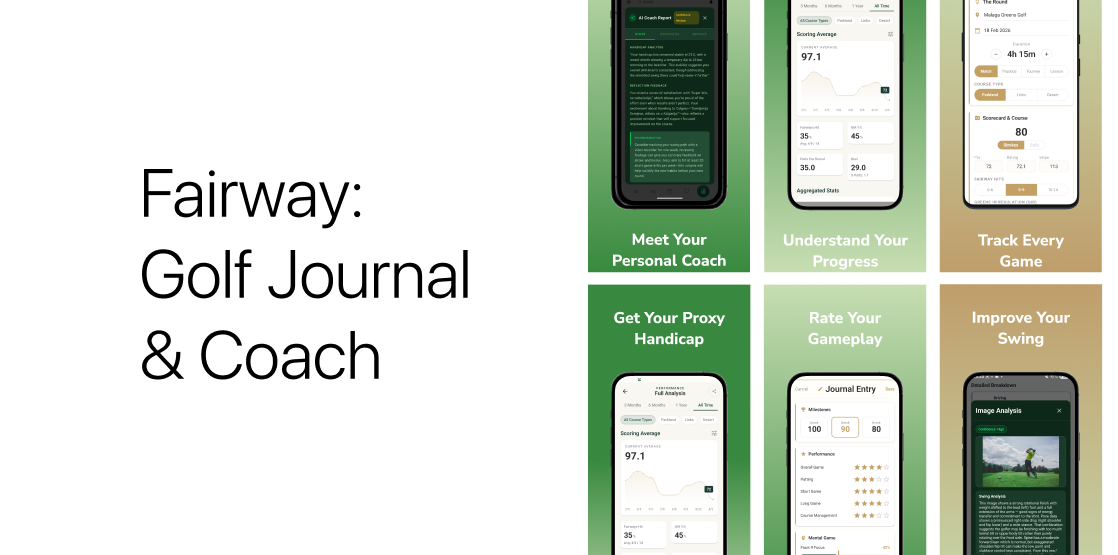
Fairway builds that persistent coaching picture, tracking your rounds, your swing, and your improvement arc across every session, so every coaching report gets sharper the longer you use it. Download free on iOS and Android and get your first coaching report today.
------------
Frequently Asked Questions
Can AI replace a golf coach? AI coaching is great at swing analysis, biomechanical measurement, and processing longitudinal performance data in ways that are difficult for a human coach working alone. What it can't replicate is the intuition, emotional attunement, and real-time adaptability of a skilled human coach who has spent years reading golfers under pressure. The most effective approach treats AI as a supplement to coaching rather than a replacement for it.
How accurate is AI golf swing analysis? Research backs up the accuracy claims. A recent study from Auckland University of Technology found that a deep learning model achieved 96.88% classification accuracy for detecting swing defects. The main limitation is that AI analyses against predefined models and may not account for individual anatomical differences without being explicitly prompted to do so.
What does an AI golf coach actually do? AI golf coaching covers three distinct capabilities. Swing analysis uses computer vision to measure body positions, joint angles, club path, and face angle from video. Performance analytics processes your round data and logged sessions to identify patterns, weaknesses, and trends over time. Coaching dialogue allows you to ask questions, set goals, and receive guidance between lessons. The first two are well-established with strong research support; the third is improving rapidly but works best with a defined, narrow focus.
Is AI golf coaching worth it for amateur golfers? For golfers who want to improve, yes. AI addresses the feedback loop gap between rounds as most amateur golfers have no objective way to know whether a swing change is actually taking hold, which specific distances are costing them the most shots, or whether their performance trends are moving in the right direction. AI coaching makes that feedback available between lessons, between sessions, and across the full arc of a season rather than only in the moments when a coach is present.
What are the limitations of AI golf coaching? The main limitations fall into three areas. In swing analysis, AI systems analyse against reference models and may misread positions that are atypical but optimal for a particular golfer's build — human interpretation adds value here. In coaching dialogue, current AI can't read emotional state, adjust for fatigue, or notice the things a present coach would pick up on intuitively.
How is AI golf coaching different from a regular golf lesson? A lesson gives you a highly skilled human observer for 30–60 minutes. AI coaching gives you continuous, data-driven feedback across every round and session. The most productive use of both is together: bring your AI coaching data to a lesson so your coach can spend time on interpretation and adjustment rather than diagnosis from scratch. Golfers who arrive with logged rounds and trend data consistently report more productive lessons.
Does AI golf coaching work for high handicappers? Yes! And arguably more so than for low handicappers. High handicappers typically have larger, more consistent weaknesses that show up clearly in performance data, making the pattern-finding capabilities of AI coaching especially useful. A 20-handicapper who discovers from their data that approach shots from 100–130 metres are costing them two shots per round has a clear, actionable target. That kind of precision is valuable at any level, but the improvement opportunities tend to be larger and more distinct at higher handicaps.
What's the best AI golf coaching app? The most useful AI coaching apps are those that combine statistics from your game across multiple rounds rather than analysing in isolation. The full coaching picture comes from an AI coach that knows your round history, your swing patterns, and your improvement arc together, and uses all three to generate specific guidance rather than generic advice.