Why Golf Swing Analysis Matters More Than You Think
Every golfer, from beginners to single-digit handicaps, faces the same frustrating question: “Why did that shot go there?”
A slice, a hook, a topped shot - they often feel random. But they’re not. They are the direct result of how your body moves through the swing.
That’s where golf swing analysis comes in.
Understanding your swing is the fastest way to improve consistency, reduce mistakes, and lower your handicap. Without it, you’re guessing. With it, you’re making deliberate progress.
The Foundation: What Ben Hogan Got Right
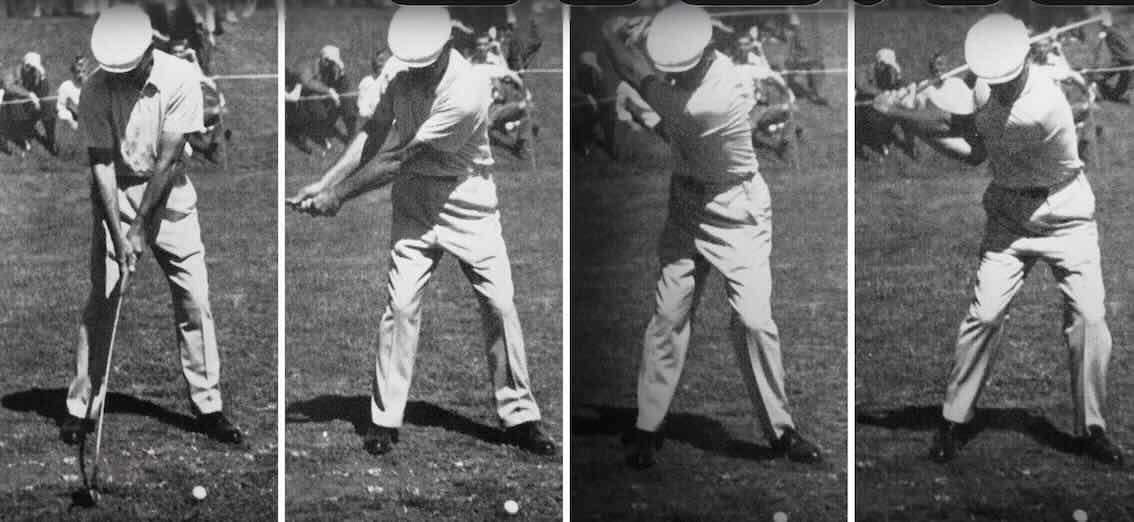
Long before AI and high-speed cameras, Five Lessons: The Modern Fundamentals of Golf by Ben Hogan laid the groundwork for modern swing understanding.
Hogan broke the swing into fundamentals that are still relevant today: grip, stance, posture, backswing, downswing.
What made his approach powerful wasn’t complexity - it was clarity. Small deviations in body position lead to predictable ball flights.
Modern golf swing analysis tools, including AI golf swing analyzers, are essentially doing the same thing - just faster, more precisely, and with measurable data.
The Key Body Mechanics Behind Every Golf Swing
If you strip the swing down to its essentials, a few key elements define everything:
Stance and Feet Position
Your feet set the foundation. Too narrow creates instability, too wide limits rotation. Shoulder-width is a reliable baseline.
Knee Flex and Balance
A slight knee flex allows movement and balance. Locked knees or excessive bending both introduce inconsistency.
Hip and Shoulder Alignment
This is one of the biggest hidden issues:
- Open shoulders → slice tendency
- Closed shoulders → hook tendency
Swing Plane
The club path defines your ball flight:
- Outside-to-inside → slice
- Inside-to-out → draw or hook
Impact Position
Everything leads to impact. A solid position typically includes:
- Hands ahead of the ball
- Weight shifted forward
- Square clubface
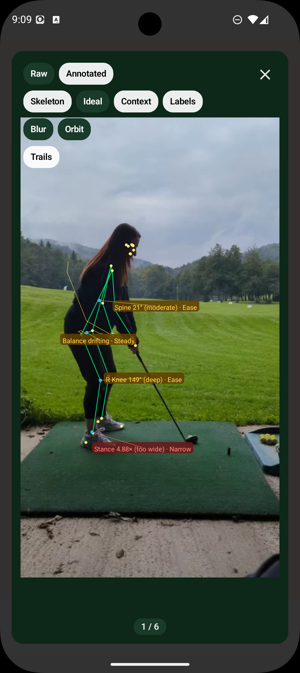
The Problem: What You Feel vs What Actually Happens
Most golfers rely on “feel" but the problem is simple: feel is often wrong. You might feel square but be open; you might feel balanced but be falling back.
This gap between perception and reality is exactly where golf swing analysis becomes essential.
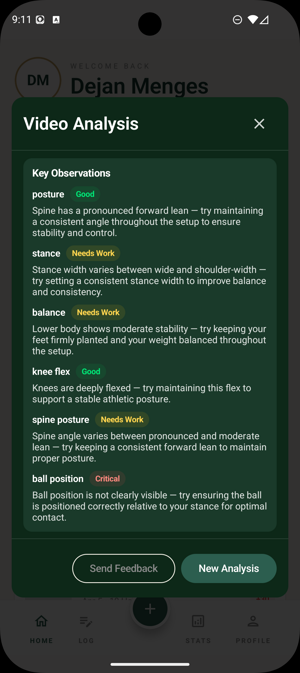
Enter AI: The Next Evolution of Golf Swing Analysis
Traditionally, proper analysis required a coach or expensive equipment. Now, AI golf swing analysis brings that capability into your pocket.
An AI golf swing analyzer can:
- Detect body positions (shoulders, hips, knees, wrists)
- Measure angles precisely
- Highlight deviations from ideal positions
- Provide immediate, visual feedback
This turns abstract advice into something you can actually see and act on.
AI + Human Coaching: The Smart Combination
It’s important to be clear: AI is not a replacement for a human coach.
A great coach brings experience, context, and the ability to adapt instruction to your specific game.
But AI golf assistants add something powerful alongside that:
- You can analyze your swing anytime, not just during lessons
- You come to your coach with concrete observations
- You ask better, more precise questions
- You retain feedback better because you can revisit your own swings
Instead of replacing coaching, AI makes coaching more effective.
It turns sessions from: “Something feels off” into: “My shoulders are open at impact — how do I fix that?”
That’s a completely different level of conversation.
From Theory to Practice: Making Analysis Actually Useful
Knowing your swing is one thing. Improving it is another.
The most useful golf swing analyzer tools are:
- Visual - you clearly see what’s happening
- Comparable - against ideal positions, and
- Actionable - they tell you what to change.
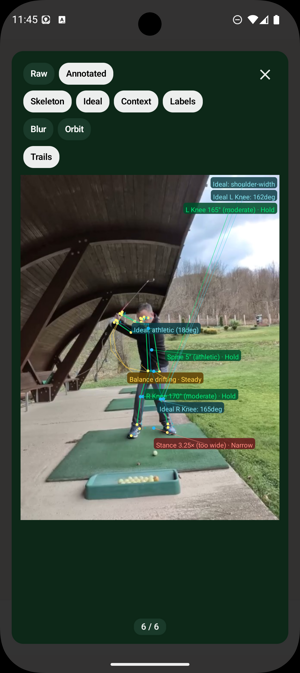
With tools like Fairway: Golf Coach and Journal, you can:
- See your swing with overlaid body angles
- Spot misalignment in shoulders, knees, and hips
- Understand why a shot happened
- Get simple, focused corrections
This bridges the gap between theory and real improvement.
Why This Matters for Your Game
Improvement in golf doesn’t come from hitting more balls.
It comes from understanding what you’re doing.
With proper golf swing analysis, you:
- Build repeatable mechanics
- Eliminate bad habits faster
- Gain confidence in your swing
- Improve consistently over time
And with AI golf swing analysis, that process becomes faster, clearer, and always available.
FAQ: Golf Swing Analysis & AI Tools
What is golf swing analysis?
Golf swing analysis is the process of evaluating your body movement and club path to understand and improve your shots.
How does an AI golf swing analyzer work?
It uses computer vision to track body positions and compare them to ideal swing mechanics, giving you visual and data-driven feedback.
Is AI golf swing analysis accurate?
It’s highly effective for posture, alignment, and swing path. While not a full replacement for coaching, it provides consistent and objective insights.
Can AI replace a golf coach?
No. AI complements a coach by helping you practice between lessons and better understand feedback — but it doesn’t replace human expertise.
How can AI help me work with a coach?
It helps you identify issues earlier, track progress, and ask more specific questions, making your coaching sessions more productive.
What should I focus on first in my swing?
Start with stance, posture, and alignment. These fundamentals influence everything else in your swing.