Golf lessons are expensive. Not just in money, but also in time, in the mental energy of being observed and corrected, and in the weeks of practice required to make the changes stick afterwards. Most golfers know this, which is why they show up to lessons with good intentions: "I want to hit it more consistently," "my puts have been a bit off," "I just feel like something's not quite right."
These are descriptions of how the game feels; however, they're almost useless to a coach.
The most effective lessons occur when the student specifically communicates what the ball is doing when things go wrong. You don't need to know what's causing it; that's the coach's job. But if you have specific goals or know what you miss, it can help your instructor get to the issue more directly.
The problem is that most golfers don't arrive with that specificity because they don't have it. They know something is wrong. They don't know exactly what, exactly where, or exactly how often. That diagnosis process should happen before the lesson, but often ends up consuming the lesson itself.
Fairway changes that. The data you've been logging across your rounds and sessions is the briefing document your coach needs. Here's how to use it.

Do I really need a Journal?
Tiger Woods is well known for keeping a strong practice of physical journaling. Karl Morris is widely regarded as Europe's leading golf performance coach, having worked with six Major winners and over 100 PGA Tour, European Tour, LPGA and Ladies European Tour golfers. Journaling is a tool he consistently advocates across that client list.
Professional golfers keep a journal because it makes the coaching they invest in more productive. Every hour with a coach is expensive at any playing level. A journal makes those hours count.
What your coach actually needs from you
Preparation, both mental and physical, is key to a productive coaching session. Reflecting on specific aspects of your game you want to improve and noting down any questions or goals keeps the lesson focused.
But "reflect on your game" is advice that assumes you have an accurate picture of it. Most golfers don't, because human memory is a poor data source. The rounds that stay on our mind are the dramatic ones. The consistent, subtle patterns that most determine your handicap are exactly the ones that are hardest to spot across a season.
What a coach actually needs isn't your emotional summary of how the game has felt. It's:
- Which specific situation has cost you the most shots across your recent rounds
- Whether that weakness is consistent or varies by conditions
- What you've already tried to fix it, and whether it made any difference
- What your swing positions look like now, with measurements, not impressions
All four of those things live in your journal data.
How to prepare for the lesson?
Step 1: Open your journal entries from your last five rounds
Before you do anything else, read back through your last five round entries, specifically the section where you logged where the strokes went.
You're looking for the pattern that appeared most frequently. Not the worst shot of any individual round, but the situation that kept showing up: the distance range where your approach play repeatedly broke down, the shot type that cost you in round three and round five, the back nine scoring that was higher than the front nine across multiple entries.
That pattern is your lesson agenda. If the same weakness has appeared in four of your five most recent rounds, your coach doesn't need to spend the first 20 minutes diagnosing and can work on improvements.
Write it down in one specific sentence before you leave for the lesson. Not "my irons", but more specific like "I'm consistently leaving approach shots short and right from 130–150 metres, especially under any kind of pressure."
Knowing your miss and communicating it clearly helps your instructor spot the issue directly and structure the lesson time much more efficiently. Money saved!
Step 2: Check your swing analysis trend
Before your lesson, review your last two or three analyses and note:
- Which positions are still flagged for imrpovement
- Whether the positions your coach addressed last time have actually changed
- What your current knee angles, spine tilt, and stance measurements look like
Arriving with this information allows your coach to verify their previous recommendations rather than starting from scratch. If you worked on spine tilt for six weeks and it's improved, your coach knows the fix is working and can move on. If nothing has changed, they know the drill isn't transferring and can try a different approach.
Data from tools like Fairway can help by giving the coach and the student an objective baseline rather than relying on feel alone.

Step 3: Review your lesson history and drills
Open your last lesson entry. What did your coach identify? What was the one focus they gave you to take away?
This matters for two reasons.
First, it tells you whether what they suggested has actually made it into your game. If your last lesson focused on maintaining spine angle through impact and your swing analyses since then show no change in that measurement, you can tell your coach honestly that the practice plan is not working. Which means they can try a different explanation, a different drill, or a different angle on the same problem.
Second, it prevents the common pattern of lessons that don't compound. Players who get the most out of golf instruction are the ones who learn & practice. When each lesson starts from the previous lesson’s takeaway, the coaching relationship builds. When each lesson starts from a blank slate, you're paying for the same lesson you had before.
Step 4: Prepare two or three specific questions
Armed with your journal patterns, your swing analysis results, and your last lesson notes, you can now prepare questions that go beyond "what should I work on?"
Specific questions produce specific answers. Examples:
- "My approach data shows I'm consistently losing shots from 130–150 metres. My last swing analysis showed my spine tilt was still not there°. Is that the cause, or is there something else I should be looking at?"
- "I logged a practice session working on the drill you gave me last time, but the next three rounds showed the same leak. Can we look at whether the drill is transferring?"
- "My journal entries show my back nine scoring is consistently worse than my front nine across the last eight rounds. Is that a technique issue or a focus/fatigue pattern?"
If certain aspects feel challenging, make notes to discuss with your coach at your next session rather than attempting major adjustments on your own. Your journal is exactly that note: a structured, data-backed record of what's been challenging and where the game is breaking down.
Step 5: Log the lesson in your journal immediately after
This step is the one most golfers skip, and it's the one that makes all the others compound.
Before you leave the lesson facility, open your journal and log the session. Two to three sentences is enough: what your coach identified, what the one focus is for your next sessions, and any specific drill or feel cue they gave you.
This note becomes the context for everything that follows. It connects the coaching to your rounds. If your following rounds improve, the coaching is working. If they don't, the data will tell that something in your game needs to change.
Keeping a journal to monitor progress and document changes in your game provides information that helps both you and your instructor make informed decisions about future training plans and ensures continuous improvement. Fairway makes that journal the foundation of everything, and the lesson entry is the link that connects professional coaching to everything you do between sessions.
What this looks like in practice
Here's the difference between typical lesson preparation and proper preparation.
Typical preparation: "I've been struggling a bit with my irons lately. I want to hit it more consistently."
Well-intended preparation: "My last five round entries show I'm losing the most shots on approach from 130–150 metres. My swing analysis shows my spine tilt is still flagged at moderate severity despite working on it for three weeks. My last lesson note says we focused on maintaining spine angle through impact. I don't think it's translating yet. I want to know why, and what to try differently."
How Fairway makes it automatic
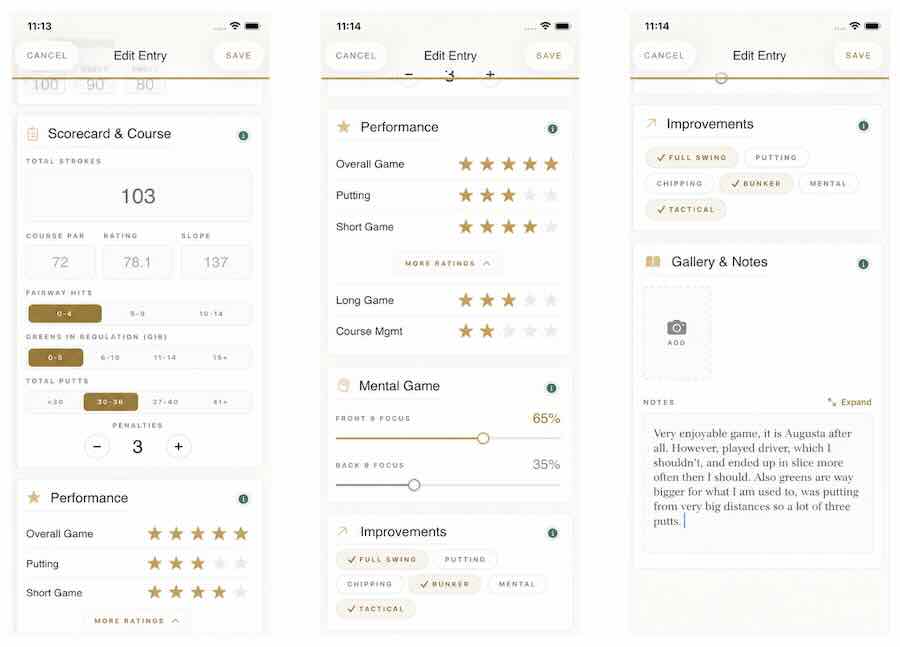
Within Fairway Golf Coach & Journal, the post-round journal is the foundation. Every round, practice session, and lesson is captured in one place, combining session type, scores, fairway hits, GIR, clubs worked on, and personal reflections into a connected history of your game.
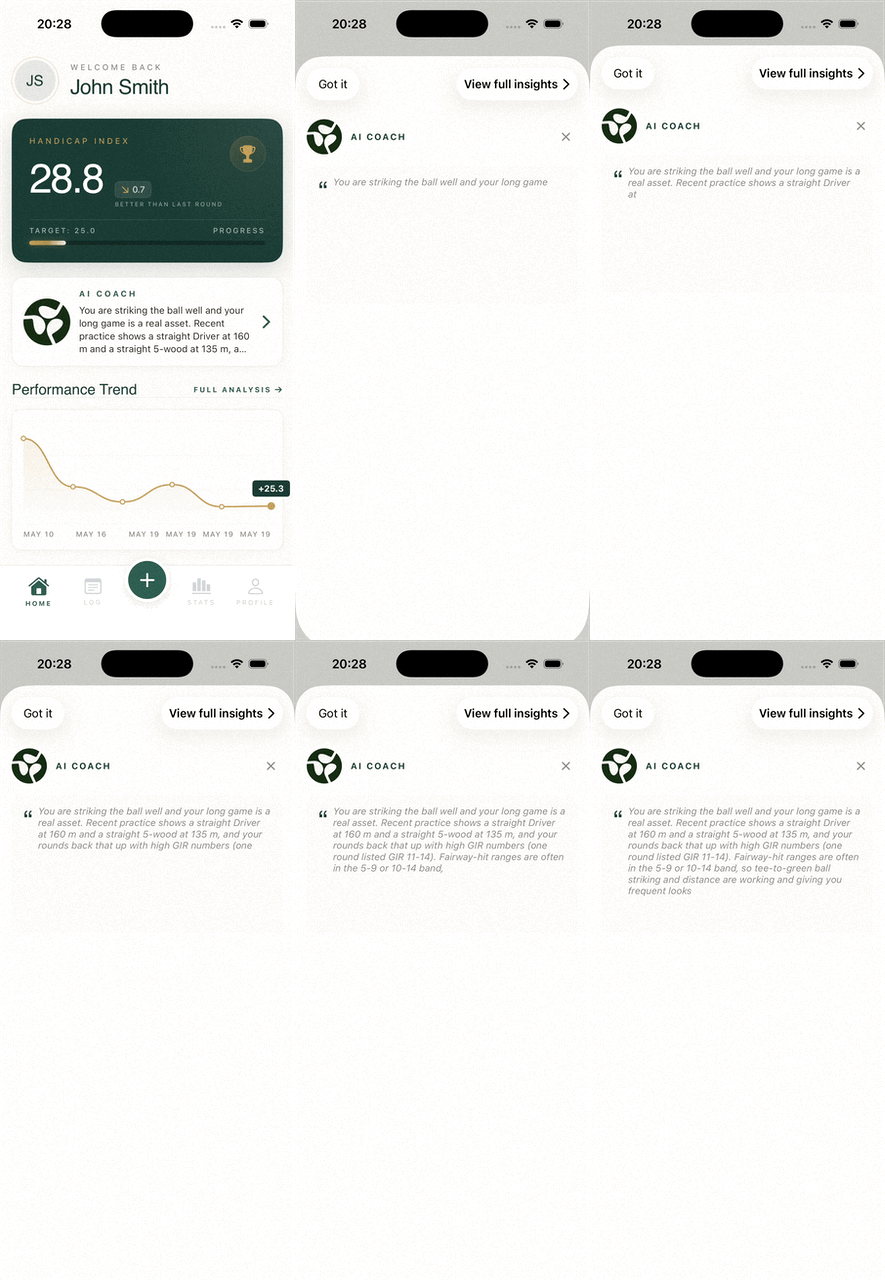
Over time, the AI coach analyses this data to identify patterns that are difficult to spot in a manual journal alone. It turns isolated sessions into a clear picture of how your game is actually evolving. From that, coaching reports are generated for both you and your coach.
The result is better preparation for every lesson. Instead of reconstructing what happened since the last session, your coach sees your documented rounds, swing analysis trends, previous lesson notes, and the primary weakness emerging from the data.
That changes how lesson time is spent. Your coach spends 45 minutes coaching instead of diagnosing. Progress between lessons becomes visible, measurable, and directly connected to the next session.
That’s how a journal reduces coaching costs. Not by replacing the coach, but by making every minute with them more valuable.
-------
Log your sessions, track your swing, and arrive at every lesson with the data your coach needs. Download Fairway free on iOS and Android — no credit card required.
--------
Frequently asked questions
What should I tell my golf coach before a lesson? Tell them the specific situation where your game breaks down most consistently, the distance, the shot type, and the moment it fails. If you have data showing how often it appears across recent rounds, share that. If you've been working on something they suggested previously, tell them honestly whether it's transferred to your rounds. The more precise your briefing, the more targeted the lesson can be.
How do I get the most out of a golf lesson? Prepare specifically, arrive with data rather than impressions, ask precise questions, and log the lesson immediately afterwards so the takeaway doesn't fade. The golfers who improve most consistently from lessons are those who treat each lesson as one step in a continuing coaching relationship rather than a standalone event, which means starting from the previous lesson's takeaway and ending with a clear note to carry into the next one.
Is a golf journal worth it if I only take occasional lessons? Yes. Golfers who take lessons infrequently have longer gaps between sessions, which means more rounds of data to review and more opportunity for documented patterns to accumulate. An occasional-lesson golfer who arrives with months of structured journal entries, showing consistent weaknesses, attempts at self-correction, and their outcomes, gives a coach far more to work with in a single session than one arriving with a general question. The journal effectively extends the coaching relationship into the space between lessons, making each session more valuable precisely because it's less frequent.
How much money can a golf journal save on lessons? The savings depend on lesson frequency and cost, but the proof is clear. Eliminating the diagnostic phase from each lesson effectively gives you more coaching per session, documented continuity reduces repetitive diagnosis across a series of lessons, and targeted between-lesson practice means you progress faster. As a result, you require fewer total lessons to reach the same improvement goals.
How does Fairway data help in a golf lesson? Fairway gives you three things a typical golfer walks into a lesson without: a data-backed identification of your most consistent performance leak, a swing analysis history showing whether positions have changed since your last coaching session, and logged lesson notes from previous sessions. Together, these turn a 45-minute lesson from a diagnostic session into a targeted coaching session, which means more progress for the same investment of time and money.